Disclosure that holds up under audit — asset by asset, every reporting cycle.
Asset-level disclosure across CSRD/ESRS, EU Taxonomy, SFDR and AIFMD II, aggregated to portfolio and fund level — computed from curated public data, with a methodology that any auditor can follow to source, and reproduced every reporting cycle rather than bought once. We are the author of the disclosure, not merely its messenger.
The frameworks we disclose against.
CSRD / ESRS
Scope 1/2/3, avoided emissions, and the ESRS topical standards, per asset and rolled to the fund.
EU Taxonomy
Activity 4.10 substantial-contribution screening + DNSH, with the Article 8 turnover/CapEx/OpEx KPI.
SFDR
Principal adverse impact (PAI) indicators for Article 8/9 fund reporting.
AIFMD II
Risk-management and liquidity framing at fund level, aligned to Directive 2024/927.
Australia AASB S2
ISSB-aligned climate disclosure — the same engine, a non-EU jurisdiction.
View the sample →Community and grid — in regulatory terms.
Our valuation prices what an asset returns to its owner, its investors, its community and the grid. On the disclosure side, that same community- and grid-impact analysis isn't a figure — it's evidence: we cross-walk each dimension to the obligation it satisfies, so the ESRS and Taxonomy claims are shown, not asserted.
Affected communities
Local health, energy access and welfare effects, mapped to the "affected communities" standard and the relevant principal-adverse-impact indicators.
Grid & system contribution
The substation's role in absorbing renewables and deferring network reinforcement — the substance behind the Activity 4.10 "substantial contribution to climate-change mitigation" test.
Ecosystems & biodiversity
Land use and proximity to protected areas, screened against the biodiversity standard and the Taxonomy do-no-significant-harm criteria.
Evidenced at the node
The same substation-level model that computes community and grid value backs these disclosures — a bridge the pure compliance houses can't make.
Community & environment — shown as evidence.
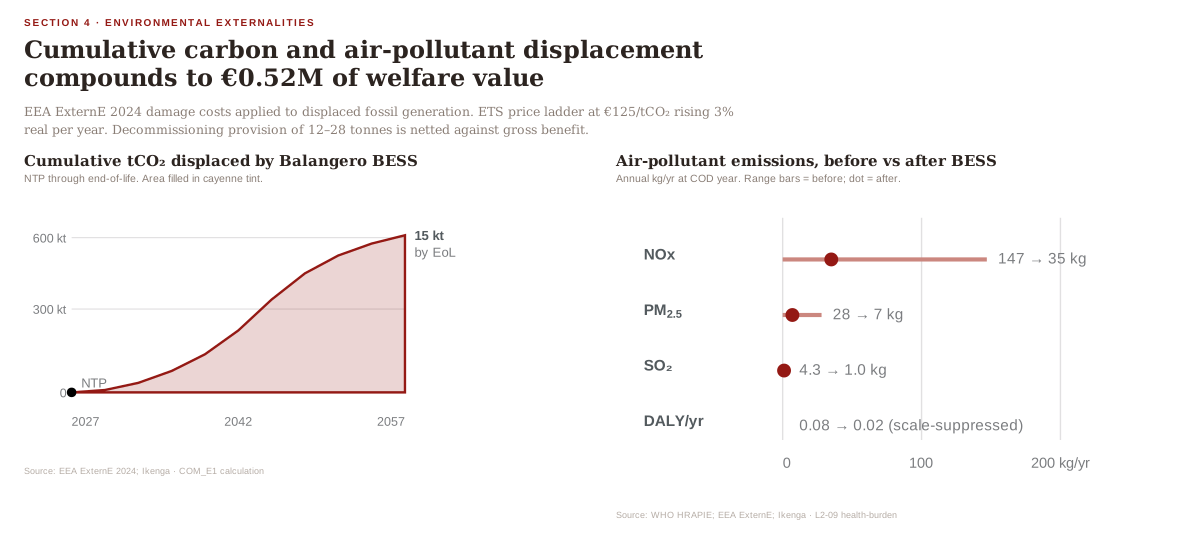
Rendered by the platform, every figure traceable to a curated public source. Illustrative output on Ikenga's own methodology portfolios.
What a sample report contains.
Every disclosure is a rendered document, not a score. The redacted sample walks the full structure — figures dummied, methodology intact.
Cover & asset identity — node, capacity, connection
Double-materiality assessment
Scope 1/2/3 — with Battery-Reg lifecycle carbon
EU Taxonomy alignment + DNSH 6-criteria
SFDR PAI indicators
Community & grid cross-walk — ESRS S3 / E4 / Taxonomy 4.10
Audit trail — every figure to its curated public source